WhatsApp gets a 98% open rate. Email sits around 21%. On paper, that looks like a landslide.
But I’ve run both channels long enough to know that open rate tells you who saw your message, not who bought anything.
The real question is which channel gets people to actually do something. And the answer depends entirely on what you’re asking them to do.
That’s what I’ll break down here: not which channel “wins,” but which one is right for the specific job you’re trying to get done.
In This Article
- The short answer: which is better, WhatsApp or email?
- WhatsApp vs email marketing: the numbers side by side
- Where email marketing still wins
- Where WhatsApp marketing wins
- The real ROI question: what are you actually trying to do?
- FAQ: WhatsApp vs email marketing
- Start using WhatsApp and email together now
The short answer: which is better, WhatsApp or email?
Neither one is universally better. They’re built for different moments in the customer journey.
Email is where you build the relationship. It’s the right tool for nurturing cold audiences, sending long-form content, and running the kind of deep automation that takes weeks to play out.
It scales well and costs the same whether you’re messaging 100 people or 100,000.
WhatsApp is where you close. It’s faster, more personal, and gets responses in a way email rarely does.
For high-intent follow-ups, time-sensitive offers, or anything where a two-way conversation matters, it consistently outperforms email on every engagement metric.
The businesses I see getting the best results from both channels use email to build and educate, then bring WhatsApp in at the moment someone is ready to make a decision. One channel warms the lead. The other closes it.
WhatsApp vs email marketing: the numbers side by side
Before getting into when to use each channel, here’s where they actually stand against each other.
| Metric | WhatsApp Marketing | Email Marketing |
|---|---|---|
| Average open rate | ~95-98% | ~20-21%* |
| Click-through rate | ~45-60% (promotional campaigns) | ~1-5% |
| Response rate | ~40-60% | ~1-6% |
| Conversion rate | 3-28% depending on industry | 1-3% |
| Open velocity | ~80% read within 5 minutes | 6-24 hours |
| Deliverability | 97-99% (no spam filters) | 80-85% |
| List building | Explicit opt-in via phone number | Opt-in via email address |
| Automation | High, but template-restricted | Extensive and layered |
| Cost model | Per-message | Subscription/flat rate |
* A note on that email open rate: current reported benchmarks from Mailchimp and HubSpot actually show 35-45%, not 20-21%. The difference is Apple’s Mail Privacy Protection, which has been pre-loading email tracking pixels since 2021 and recording “opens” whether or not a real person saw the message. The 20-21% figure reflects real human engagement before that inflation kicked in. It’s worth knowing, because it means the gap between WhatsApp and email looks even larger on paper than it is in practice.
What these numbers actually mean
The WhatsApp open rate needs context. When someone gets a WhatsApp message, they’re usually already in the app for personal reasons. Your marketing message benefits from that.
They see it because they were already there, not because they chose to engage with your brand. That’s different from someone opening an email, which is at least a small act of deliberate attention.
That said, the response and click-through rates tell a different story.
The borrowed attention is clearly converting. A 40-60% response rate versus 1-5% for email isn’t a small gap, and it shows up consistently across industries. WhatsApp messages get acted on in a way that email, buried in a Promotions tab, simply doesn’t.
The stat I find most useful is the open velocity one.
Around 80% of WhatsApp messages are read within five minutes of being sent. For email, that same message might sit unopened for six hours or more.
If timing matters to what you’re sending, that difference alone changes which channel you should be using.
For data sources: open rate and CTR figures are drawn from Meta’s WhatsApp Business data, Mailchimp’s Email Benchmarks, and HubSpot’s State of Marketing report.
WhatsApp conversion rates vary widely by industry: beauty and healthcare see rates up to 28%, while general e-commerce sits closer to 5%.
If you’re trying to capture more leads from the people already visiting your site, we cover that in detail here: how to capture leads from your website visitors.
Where email marketing still wins
I want to be direct here: if you’re already running email marketing, you’ve built something that works. WhatsApp doesn’t replace that. Here’s where email genuinely has the advantage.
Scale, infrastructure, and automation depth
Email platforms like ActiveCampaign, Klaviyo, and ConvertKit let you build automation sequences that run for weeks, branch based on user behavior, and test variations at no extra cost per send.
The WhatsApp Business API (the developer-tier access layer that enables bulk messaging and CRM integration) requires Meta to approve every outbound marketing template, and per-message pricing makes large-scale experimentation expensive.
I use email to figure out which messages actually work before pushing them anywhere else.
Cold outreach and initial list building
Email works like a fishing net. It can pull in cold audiences at scale, and people are more comfortable sharing an email address with a brand they’ve just discovered than handing over a phone number.
Cold WhatsApp outreach is essentially off the table in 2026. Meta’s policies combined with GDPR and TCPA make unsolicited messages legally hazardous and a fast path to getting your account banned.
Long-form content and brand storytelling
Email is a lean-back medium. People check their inbox expecting to read something.
WhatsApp is a lean-forward conversation channel, and messages longer than a few sentences tend to get ignored. If you sell something with a long sales cycle, email sequences are where that story gets told.
Advanced segmentation and retargeting
Email connects deeply with your CRM, WooCommerce, and Shopify, so you can segment by purchase history, last login, order value, and more.
A win-back sequence for lapsed customers can fire automatically with personalized product recommendations.
Running the same campaign through WhatsApp API would cost you per message, which makes wide-net retention unviable at scale.
If you’re weighing live chat against email for on-site conversions specifically, I cover that here: live chat vs email: which drives more conversions for WordPress businesses.
Where WhatsApp marketing wins
Hyper-engagement and instant visibility
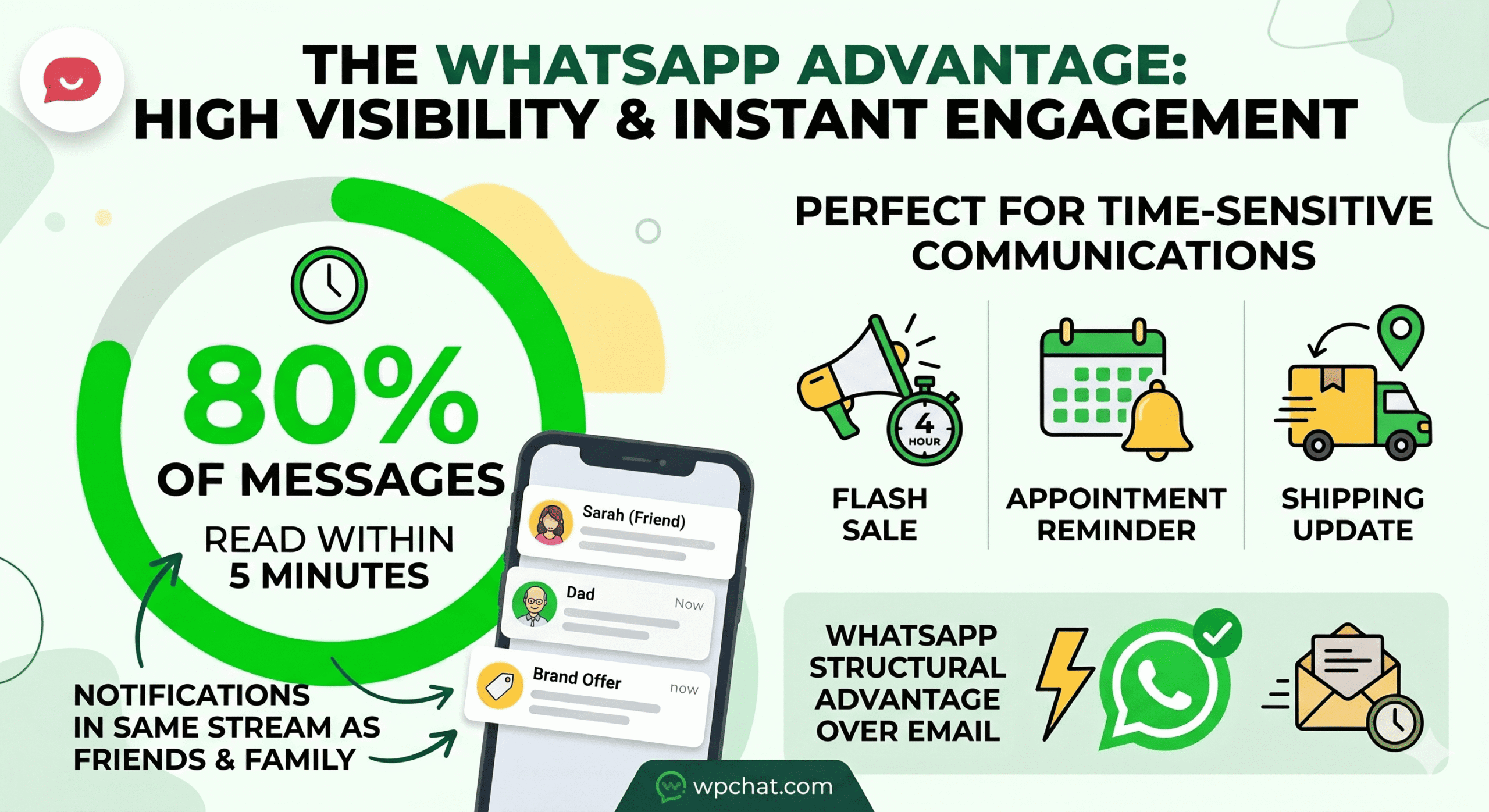
Around 80% of WhatsApp messages are read within five minutes of being sent. That’s not because people are more interested in your brand. It’s because WhatsApp notifications land in the same stream as messages from friends and family.
For anything time-sensitive, a flash sale with a four-hour window, an appointment reminder, a shipping update, that speed is a structural advantage email can’t match.
Two-way conversation and conversational commerce
WhatsApp’s response rate sits at 40-60%, which is roughly 12 times higher than email.
That matters most at the bottom of the funnel, when someone has a specific question standing between them and a purchase.
A customer on your pricing page who wants a quick answer isn’t going to send an email and wait a day, but they will message you on WhatsApp and expect a reply within minutes.
Trust, familiarity, and market-specific fit
In large parts of the world, WhatsApp is simply how people communicate: LATAM, India, the Middle East, most of Europe. A message from a business there feels personal and direct in a way that a formal email doesn’t.
The WhatsApp Business API also supports rich media like product images and in-chat catalogs, which builds a different kind of engagement than a static email template ever could.
Mobile-first audience alignment
Over 85% of global internet traffic is mobile, and the WhatsApp experience is built entirely around that.
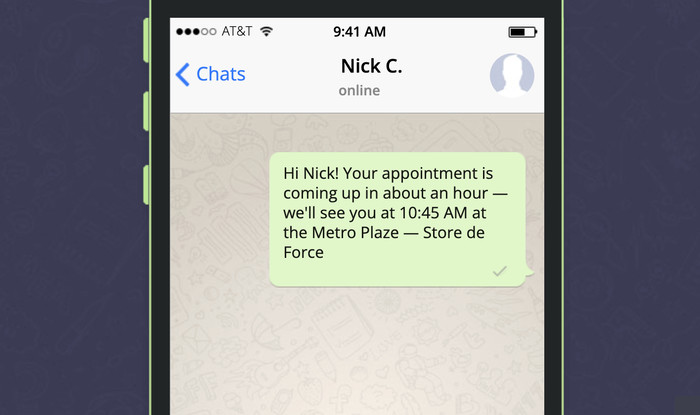
Email on mobile still involves opening an app, loading a message, tapping a link, and waiting for a page to load. WhatsApp keeps more of the journey inside a single fast app. For audiences who live on their phones, that reduction in friction adds up.
If you’re thinking about adding chat to your site more broadly, this guide covers your options: how to add social media chat to your website.
The real ROI question: what are you actually trying to do?
Open rate doesn’t tell you which channel to use. The job you’re trying to get done does.
Use email when…
- You’re nurturing a cold or warm audience over weeks or months
- You’re sending long-form content: newsletters, guides, or educational sequences
- You need automation triggered by complex behaviors or multi-step conditions
Use WhatsApp when…
- You want a reply, not just a read: a booked call, a quote request, a question answered
- You’re following up on high-intent leads who abandoned a cart or requested a demo
- The message is time-sensitive: a flash sale, a 2FA code, a real-time shipping update
- Your audience is in a WhatsApp-dominant market like LATAM, India, or the Middle East
H3: Use both when…
- Email handles the top and middle of the funnel; WhatsApp closes at the bottom
- You’re running cart recovery: email sends the first reminder, WhatsApp follows up an hour later
- A lead comes in through an email opt-in, but the high-intent follow-up happens via a WhatsApp button on the thank-you page
Adding WhatsApp to your WordPress site? WPChat puts a WhatsApp button on your site so visitors can message you directly from any page. Add WhatsApp to Your WordPress Site with WPChat
FAQ: WhatsApp vs email marketing
H3: Is WhatsApp better than email for marketing?
It depends on what you’re trying to do. WhatsApp outperforms email on engagement speed, response rates, and bottom-of-funnel conversions. Email wins on scale, long-form content, and complex automation. The most effective approach uses both: email to nurture, WhatsApp to close.
H3: What is the average WhatsApp marketing open rate?
WhatsApp marketing messages see open rates of 95-98%, compared to around 20-21% for email based on real human engagement. About 80% of WhatsApp messages are read within five minutes of being sent, which makes it a different tool than email for anything time-sensitive. Worth noting: that high open rate is partly because people are already in the app for personal reasons, so your message gets seen whether or not they intended to engage with a brand.
H3: Can I automate WhatsApp marketing like email?
Yes, but it works differently. Through the WhatsApp Business API, you can set up automated sequences triggered by CRM events or on-site behavior. The catch is that Meta requires all outbound marketing messages to use pre-approved templates, and you pay per message, so it’s more constrained than the open-ended automation you’d build in an email platform.
H3: Is WhatsApp marketing legal?
Yes, as long as you have explicit, documented consent from every contact before you message them. Sending to scraped lists or people who never opted in risks immediate account suspension and potential legal penalties under GDPR or TCPA. When in doubt, check with a legal professional familiar with the regulations in your market.
H3: How do I add WhatsApp marketing to my WordPress site?
The easiest starting point is installing WPChat, which adds a WhatsApp chat button to your site and lets visitors message you directly from any page. From there you can layer in WhatsApp Business for broadcasts and, for more advanced automation, the WhatsApp Business API.
Start using WhatsApp and email together now
Understanding which channel does what is the first step to actually getting more out of both.
I’ve seen how much changes when you stop treating email and WhatsApp as competitors and start using each one for what it’s built for.
But having the strategy is only half of it. If you’re running a WordPress site, you also need a way for visitors to reach you on WhatsApp directly from your pages, without extra steps or friction.
That’s precisely where WPChat shines.
It adds a WhatsApp chat button to your WordPress site so anyone browsing can start a conversation instantly, from any page, on any device.
Here’s what I suggest to get started:
- Get WPChat on your WordPress site today
- Set up your WhatsApp Business profile so you’re ready to respond
- Keep using email for your nurture sequences and long-form content, and bring WhatsApp in for follow-ups and time-sensitive offers
- Watch how your response rate changes when people can reach you in the channel they actually use
Have questions about setting up WhatsApp on your WordPress site? Just let me know in the comments below.